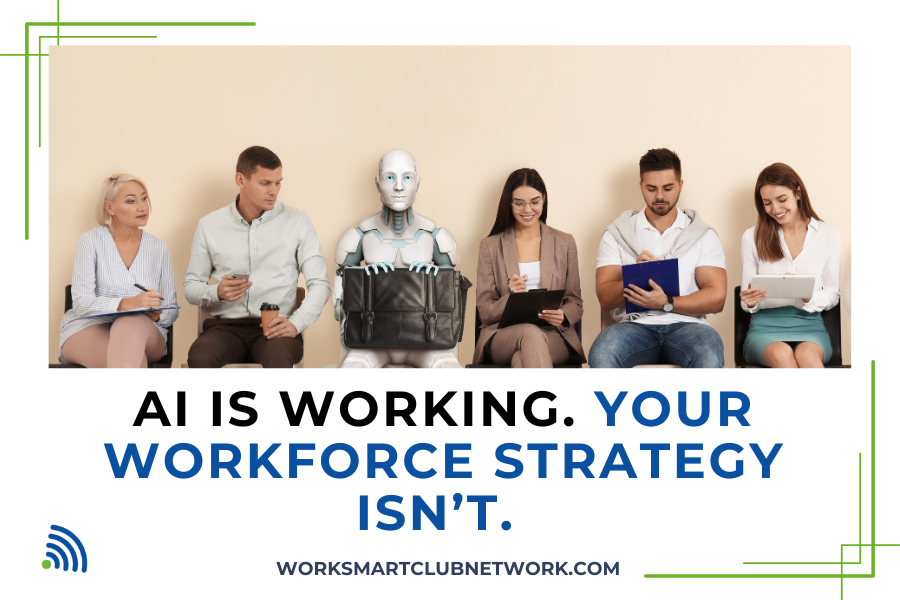
2024 Monthly Tips Download

Here you go… as we put out the Monthly Tips, you can access them here. 

Monthly Tips

Let’s talk about AI ROI.

You’re measuring AI on revenue. The real cost is hiding somewhere else entirely.

Every board meeting, every strategy session, every quarterly review — the question is the same.

What’s our AI ROI?

Leaders are tracking time saved, tasks automated, revenue influenced, costs reduced. All legitimate metrics. All important data points.

And all measuring the wrong thing.

Because while organizations are laser-focused on what AI is doing for the business, almost nobody is measuring what AI is doing to the people running it.

And that gap — the human performance gap — is quietly swallowing the returns leaders think they’re generating.

MIT Sloan Management Review and Boston Consulting Group named five workforce risks that should factor into every AI deployment decision. Most organizations haven’t assigned anyone to own them. Many haven’t even considered them.

That’s not a technology problem. That’s a leadership problem.

The Blind Spot in Your AI Strategy

Here’s the uncomfortable truth: the ROI conversation around AI is almost entirely focused on output. Speed. Volume. Efficiency.

What it ignores is the human infrastructure required to sustain those gains.

When AI is deployed without deliberate workforce strategy, five risks emerge — not eventually, not theoretically, but now, quietly, inside your team.

And because they don’t show up on a dashboard, most leaders never connect them to the performance gaps, the turnover spikes, the slower decisions, or the cultural erosion they’re already seeing.

The cost isn’t hypothetical. A 2018 Gartner report found that suboptimal decision-making at a $5 billion revenue firm cost it $150 million per year.

Scale that to your business.

One bad hire. One missed client signal. One strategic misstep made by a leader running on cognitive fumes.

What is that worth?

The 5 Workforce Risks Nobody Is Tracking

  1. Overreliance Employees stop thinking. AI fills the gap.

When AI handles enough of the cognitive work, people stop exercising the judgment muscle. Not consciously. Gradually.

They defer to the output. They skip the verification. They trust the suggestion over their own read of the room.

And when AI gets it wrong — which it does — nobody catches it, because the human who should have caught it stopped looking.

  1. Deskilling — Critical capabilities atrophy from disuse.

Skills not practiced are skills lost.

This is not metaphor — it is neuroscience. When employees stop writing, analyzing, problem-solving, and deciding independently, those neural pathways weaken.

The capability doesn’t disappear overnight. It erodes slowly, invisibly, until the moment you need it most and discover it’s gone.

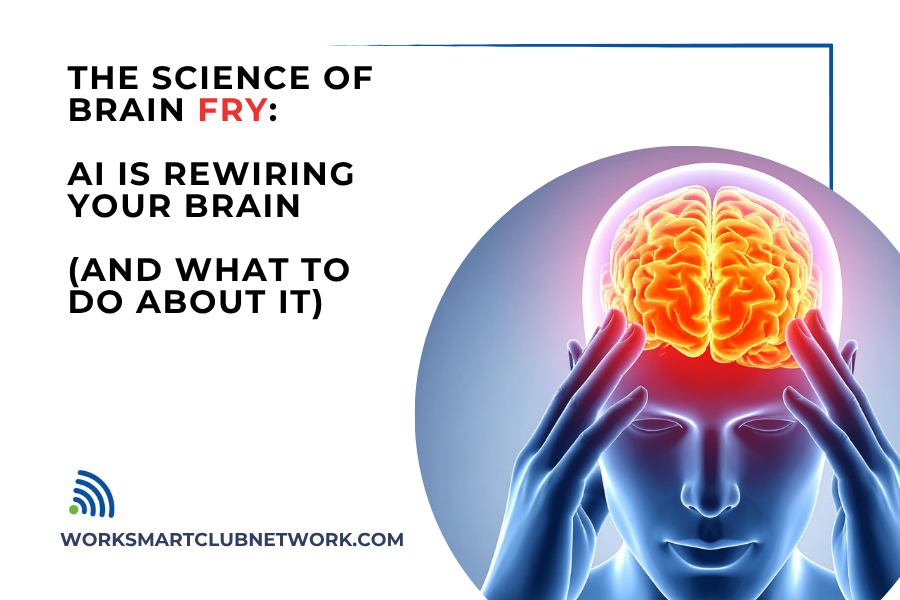
  1. Cognitive Overload (Brain Fry) — Too much monitoring creates fatigue and errors.

The assumption that AI reduces workload is only half true. For many employees, AI creates a new category of work: constant oversight, correction, and quality control of machine outputs.

Research found that workers managing four or more AI tools reported declining productivity and 39% more major errors than those who don’t experience this overload.

More tools.

More fatigue.

More mistakes.

Less of what you actually deployed AI to achieve.

  1. Job Displacement Uncertainty — Morale and performance drop when roles feel threatened.

You don’t have to actually eliminate a role for the damage to begin. The perception of threat is enough. When employees believe AI is coming for their position, engagement drops, discretionary effort disappears, and your best people — the ones with options — start looking. The AI research is highlighting that workers experiencing AI-related cognitive strain showed a higher intention to leave, compared to those who didn’t. 

Uncertainty has costs hidden in plain sight.

  1. Widening Inequality — AI amplifies top performers and leaves others further behind.

AI is a multiplier. Which means it multiplies what already exists.

High performers with strong judgment, clear priorities, and refined skills get exponentially better with AI support.

Employees already struggling — with unclear roles, inadequate training, or weak fundamentals — fall further behind. 

The gap widens. 

Fast. 

And a team with a widening performance gap is not a scaling team. It’s a fracturing one.

AI Doesn’t Create These Risks. It Exposes Them.

This is the principle most leaders resist — because accepting it means accepting responsibility.

AI doesn’t manufacture overreliance. It reveals that you never built a culture of critical thinking.

AI doesn’t cause deskilling. It exposes that skill development was never systematized.

AI doesn’t create cognitive overload. It surfaces the fact that workflow design was never intentional.

AI doesn’t generate displacement anxiety. It uncovers the reality that your people never had enough clarity about their value to feel secure.

AI doesn’t widen inequality. It amplifies a performance gap that leadership already allowed to grow.

Every one of these risks is a leadership gap wearing an AI mask. And the organizations that will thrive in this environment are not the ones deploying the most AI — they are the ones with the leadership infrastructure strong enough to handle it.

The Work Smart Approach: Assign Ownership

Every one of these risks maps directly to a performance lever. And every performance lever has an owner — you.

Check out the table below highlighting the workforce risk. I have paired with a Work Smart principle.

Use the ‘Leadership Questions’ to problem solve before you add in another AI tool or automation.
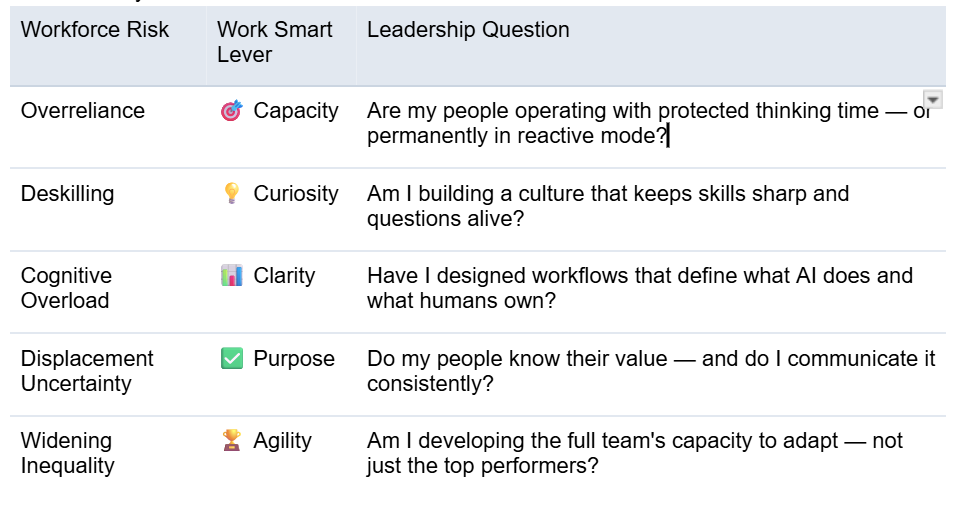
This is the framework. Assign a lever. Assign an owner. Measure it.
Because what gets owned gets managed. And what gets managed gets results.

The ROI of AI is not just what it generates. It’s what it doesn’t destroy in the process.

The leaders who close this gap first will have a compounding advantage their competitors won’t be able to replicate — because the asset they’re protecting isn’t technology.

It’s human judgment. And that’s still irreplaceable.

Find out which of these five risks is biggest in your business.

Take the free AI Readiness Gap Assessment at worksmartclubnetwork.com — and get a clear picture of where your AI deployment is leaking performance before it costs you more than you realize.

Dr. Cynthia Howard is an AI Business Growth Strategist and executive coach helping service-based leaders close performance gaps in an AI-driven world.
Monthly Tips

Something is happening to the smartest, most capable leaders in the room.

They’re making more mistakes. They’re less decisive. They feel perpetually behind despite getting more “done.” They’re reactive instead of strategic. And at the end of the day, despite a mountain of output, they feel strangely empty.

This isn’t a motivation problem. It’s not a discipline problem. It’s not even a time management problem.

It’s a thinking problem — and AI is accelerating it.

Your Brain is Your Personal Hardwired Computer.

Unlike your device, you have more than an on and off switch.

Your brain operates in two distinct modes.

Shallow thinking is fast, reactive, and automatic. Psychologist Daniel Kahneman called it System 1. It’s the brain running on autopilot — pattern-matching, scrolling, skimming, approving, clicking.

It’s efficient. It’s effortless. And it’s exactly the mode that AI rewards.

Deep thinking is slow, deliberate, and intentional. System 2. It’s the mode engaged when you wrestle with a hard decision, sit with a problem long enough to see the real root, feel genuine empathy for a client’s situation, or ask yourself what you actually want from your business and your life.

It requires stillness. It requires resistance. It requires you to stay with discomfort instead of outsourcing it.

Here’s the hard truth: your brain is hardwired to take the path of least resistance.

When shallow thinking is rewarded — with speed, with outputs, with the dopamine hit of a completed task — the brain starts to wire itself accordingly.

Neural pathways strengthen with use and weaken without it. The more you delegate your thinking to AI, the more your brain defaults to surface-level processing.

Not because you’re getting dumber. Because that’s exactly how neuroplasticity works.

You become what you repeatedly do — cognitively.

The Consequences Are Not Small

This isn’t philosophical. It’s costing you.

Brain fry — the cognitive overload that comes from constantly monitoring, correcting, and managing AI outputs — is now affecting 1 in 7 knowledge workers.

Research found that workers experiencing it make 39% more major mistakes and show 33% more decision fatigue than those who don’t.

And it’s not coming from hard work. It’s coming from a specific kind of cognitive taxation: low-depth, high-volume mental processing with no recovery.

Think of it like this: shallow thinking at scale is the cognitive equivalent of doing a thousand tiny bicep curls with no rest and calling it strength training.

The muscle doesn’t grow. It seizes.

Hair-trigger stress reactions are next. When the prefrontal cortex — the seat of your executive function, judgment, and emotional regulation — is chronically depleted, the amygdala takes over.

Your brain’s threat-detection system becomes hypersensitive. Minor friction feels like crisis. Ambiguity feels like danger. You react before you respond.

Leaders running on shallow thinking don’t just make worse decisions — they make them faster and with more emotional volatility.

And then there’s the meaning problem — the one nobody talks about.

Meaning is not built in shallow water. It is constructed in depth.

The neuroscience is clear: your brain’s Default Mode Network — the system activated during rest, reflection, mind-wandering, and abstract thought — is where you process identity, values, empathy, and long-term vision.

It’s where you ask the questions that matter: Why am I building this? What kind of leader do I want to be? Is this the life I actually chose?

When you’re in constant task mode — generating, approving, prompting, editing, switching — the Default Mode Network goes dark.

You’re too busy doing to ever be. And over time, that creates a quiet but devastating erosion of satisfaction.

High output.

Low fulfillment. A growing sense that something essential is missing — even when everything looks fine on paper.

Abstract Thinking Is Not a Luxury. It’s a Leadership Skill.

Abstract thinking — the ability to zoom out, hold complexity, connect disparate ideas, and reason about things that don’t yet exist — is the highest-order cognitive function you have.

It’s what makes a great strategist.

A visionary leader. A trusted advisor. It’s what separates the owner who runs the business from the one the business runs.

And it is the first casualty of AI overuse.

When your brain defaults to shallow thinking, abstract reasoning atrophies. You lose the ability to sit with ambiguity.

You become addicted to the clarity of a prompt-and-response loop — a world where every question has an instant answer, every problem has a suggested solution.

Real leadership doesn’t work that way. Your clients don’t work that way.

The complex, human, messy problems you’re hired to solve require a brain that can tolerate uncertainty long enough to find truth.

The leaders who will win in an AI-accelerated world are not the ones who use AI the most. They’re the ones who use their minds the most — and deploy AI strategically to amplify that thinking, not replace it.

The Work Smart Solution: Both. Always Both.

Shallow thinking is not the enemy. It’s necessary. You need fast, efficient, automated processing to move at the pace this environment demands.

The goal isn’t to slow down — it’s to build both speeds so you can consciously choose which one the moment requires.

That means deliberately protecting time for deep thinking — not because it feels good, but because your capacity, your clarity, your resilience, and your sense of purpose all depend on it.

It means treating reflection as a performance lever, not a personality preference. It means creating margins — even 5 minutes before you open an AI tool — where your brain solves the problem first.

And it means recognizing that AI, at its best, is an amplifier. It makes clear thinking clearer and confused thinking more confused. If you haven’t built the thinking infrastructure, AI will accelerate the leak — not plug it.

The question is not whether you’re using AI.

The question is whether you’re still using your mind.

Dr. Cynthia Howard is an AI Business Growth Strategist and executive coach helping service-based leaders close performance gaps and thrive in an AI-driven world. Book your free 30-Minute Leadership Gap Analysis.

Monthly Tips

For executive leaders navigating the noise — and ready to lead through it.

The Gap Is Growing. Right Now.

While you were running your last board meeting, approving Q1 budgets, or putting out the latest operational fire — AI moved again.

Not slowly. Not politely. It moved the way it always does: fast, without warning, and without waiting for you to catch up.

Here’s the uncomfortable truth most leadership development programs won’t tell you: 

the biggest threat to your organization isn’t AI replacing your people. It’s you — and your leadership team — not evolving fast enough to lead them through it.


The leaders who will thrive in the next five years aren’t the ones with the most AI tools. They’re the ones who develop the human capabilities that AI cannot replicate — and who learn to partner with AI instead of being paralyzed by it.

Most executives are already behind. The question is: what are you going to do about it?

The AI Distraction Paradox: More Tools, Less Clarity

Here’s the paradox no one talks about at the C-suite level.
Organizations are investing billions in AI tools — automation platforms, generative AI assistants, predictive analytics dashboards. And yet, leaders report more overwhelm, more decision fatigue, and less strategic clarity than ever before.

Why?

Because AI tools don’t close leadership gaps. They amplify them.

If your team lacks alignment, AI accelerates the misalignment. If your culture lacks psychological safety, AI-generated insights will be ignored or misused. If you lack clarity on your priorities, AI will give you ten more things to be unclear about — faster.

This is the AI Distraction Paradox: the more tools you add without leadership development, the more noise you create. And noise is the enemy of performance.

Think about it. When was the last time you paused — not to review a dashboard, not to approve a proposal — but to ask: Am I leading this organization, or am I just managing its chaos?

The 4 Gaps that Cost You

Through 22+ years of executive coaching and research, I’ve identified four productivity gaps that show up repeatedly in  companies and leaders often do not acknowledge them AI is only going to magnify the problem. 

Coordination Gap: The cost of people, tools, and teams working in silos. The result is misalignment, duplication, and wasted time spent coordinating work. It multiplies with growth.

Agility Gap: The cost of roadblocks, bottlenecks, like handoffs without clear definition, slow, delayed decisions, and outdated tech that stall progress. What should happen in real time takes days or weeks.

Resilience Gap: Rigid systems and lack of clear priorities leave teams stalled and slow to adapt to change. The lack of flexibility increases pressure and risks increased breakage instead of ability to bend with challenges.

Capacity Gap: Overload from too many meetings, tools, and distractions that keep employees from doing their most important work. Talent gets wasted on administrative tasks instead of impact.

What to Do About It

The quick answer is not another AI tool. It’s not another certification. It’s a leadership upgrade.

The leaders who thrive in the AI era understand that AI cannot fix disorganized systems. Leaders need to evaluate their processes and productivity and partner with AI to bring their business into the next level. 

These gaps are real. But they can be closed when the leader works with AI to understand the problem. 

Start by asking yourself one honest question: If AI is moving this fast — am I leading at the speed my organization needs?

If the answer gives you pause, that’s not a weakness. That’s awareness. And awareness is always where transformation begins.

Monthly Tips

We are living in a world where artificial intelligence is no longer a futuristic concept—it’s a present reality. From automated workflows to predictive analytics, AI is reshaping how we work, make decisions, and define success. Yet, while machines excel at speed, data processing, and pattern recognition, human ingenuity remains irreplaceable. Sustainable growth in this AI-driven era depends not on doing more but on thinking differently.

Traditional approaches to growth—scaling operations, adding clients, or increasing output—still matter, but they are no longer sufficient. In a landscape where AI can perform repetitive tasks more efficiently than any human, the differentiator is perspective: how we innovate, problem-solve, and leverage technology to amplify human potential.

Rethinking Growth: From Quantity to Quality

For decades, growth was measured by sheer output. More sales, more projects, more tasks completed—this was the standard metric of success. In the age of AI, however, output can be automated, and speed can be scaled by machines. That shifts the spotlight back to humans.

Thinking differently means focusing on the quality of your work and the impact it creates. Strategic vision, emotional intelligence, creativity, and ethical judgment cannot be replicated by algorithms. Professionals who cultivate these skills can leverage AI to maximize efficiency while ensuring that human insight drives meaningful outcomes.

To reframe growth:

  • Prioritize high-impact activities that require critical thinking.
  • Use AI to handle repetitive or time-consuming tasks.
  • Evaluate progress not just by quantity, but by long-term value created.

When growth is measured by quality rather than quantity, sustainability becomes achievable. You’re no longer racing against the clock—you’re working in alignment with outcomes that matter.

Leveraging AI as a Growth Partner

AI is not a replacement for human decision-making—it’s a force multiplier. When used strategically, AI can free mental bandwidth, reduce operational friction, and provide insights that guide smarter decisions.

However, the temptation is to see AI as an all-in-one solution. True success comes from integrating technology intentionally: letting machines handle analysis and routine execution while humans focus on strategy, relationship-building, and innovation.

This partnership transforms growth from reactive to proactive. AI identifies opportunities faster, predicts risks before they escalate, and streamlines workflows—but humans provide context, vision, and ethical guidance. The most successful leaders in the AI era are those who recognize that sustainable growth is co-created: AI enhances capacity, and humans provide judgment and direction.

Thinking differently also means embracing experimentation. AI can model multiple scenarios quickly, allowing you to test ideas with minimal risk. Those who view AI as a learning and innovation tool rather than merely a productivity booster unlock new avenues for growth that were previously impossible.

Sustaining Success Through a Human-Centered Mindset

Technology alone cannot sustain success. Sustainable growth requires energy, focus, and intentionality. It requires asking the right questions, challenging assumptions, and reframing problems in ways that AI alone cannot.

Thinking differently is about moving from efficiency to effectiveness. It’s about using technology to create more space for reflection, insight, and strategic action. It’s about aligning your decisions with long-term objectives rather than short-term outputs.

Human-centered growth emphasizes balance. High-value work, purposeful relationships, and continuous learning are what distinguish lasting achievement from temporary wins. AI may accelerate processes, but it cannot replace the judgment, creativity, or resilience that fuel enduring success.

The path to sustainable growth in the AI era begins with mindset. By thinking differently, embracing AI as a partner, and prioritizing human insight, you unlock possibilities beyond what effort alone can achieve. Growth becomes smarter, more intentional, and truly sustainable—transforming the way we work, lead, and innovate in a world powered by artificial intelligence.

In the age of AI, success is no longer about keeping pace—it’s about setting the pace. Those who adapt their thinking, optimize their energy, and integrate technology thoughtfully will thrive, while those who rely solely on traditional effort risk being left behind.

Sustainable growth is not a function of speed—it’s a function of perspective, creativity, and the ability to harness AI as a tool, not a replacement. By thinking differently, you transform potential into performance and opportunity into lasting success.

Monthly Tips

Many leaders treat marketing like a bill to pay rather than an asset to build. This conversation reframes the approach with practical steps: define a clear customer avatar, align channels to a funnel, and use geofencing to target only the devices that enter chosen locations. By creating a digital fence around competitors, events, or your own storefront, you reach the most relevant audience and prove impact with measurable foot traffic. That simple shift from generic awareness to precise proximity turns wasted impressions into qualified attention. The payoff is confidence in your spend and clarity in your strategy.

Specificity Wins: Building Campaigns Around Real Buyer Behavior

The heart of this strategy is specificity. Start with an intake that forces you into your buyer’s world: age and income, yes, but also habits, seasonality, and what triggers action. Do they browse at night on mobile? Are they price sensitive or convenience driven? If dog ownership correlates with your offer, test creatives that acknowledge it. Use A/B tests to compare audiences and messages in monthly sprints, then let the data guide iteration. This level of detail ensures your ad speaks to a real person in a real context, not a demographic caricature, which lifts relevance and lowers cost per result.

Assigning Clear Roles to Each Marketing Channel

Channel roles matter. Think of the buyer journey as a marathon. Geofencing is there at the start and middle, building awareness and nudging interest where your customer physically goes. Meta and Google excel near the finish, catching intent and harvesting demand. When combined, they feel like a helpful friend cheering you through the whole race, not a stranger urging you at the end. The result is a tighter funnel: top-of-funnel geofenced impressions, mid-funnel retargeting, and bottom-funnel conversion campaigns that fit your buyer’s pace. Budgets flow across stages based on goals, not guesswork.

Closing the Loop With Real-World Measurement

Measurement closes the loop. Early indicators like lift in key website pages, rising social engagement, and growing branded search tell you if the top of the funnel is working. For retail and restaurants, the standout metric is in-store visit tracking. When someone views an ad inside a fence and later steps into your location, you can attribute the visit and learn which fences and messages drive real-world action. That clarity reshapes decisions: sunset underperforming fences, scale winners, and refine creative to mirror behavior you actually observe, not what you assume.

Case Study: Fewer Impressions, Better Results

A case study brings this to life. An HVAC company replaced broad awareness with a geofencing-first funnel aimed at underperforming zip codes. Meta shifted from general reach to retargeting, and Google budgets were trimmed to match true intent. The outcome was more booked jobs at a lower overall spend. That’s the essence of smarter marketing: serve fewer but better impressions, keep your message relevant, and measure what matters. Over time, this approach compounds, strengthening customer relationships, community connection, and brand trust you can’t buy with sheer volume.

The Mindset Shift That Makes Marketing Work

Finally, mindset sets the tone. Treat marketing as an investment in customers, not a monthly tax. Invest in creative that speaks like a human, not a billboard. Invest in testing that answers real questions. And invest in presence—the discipline to focus on a few strategies you can execute well. Like golf, the game rewards accountability and iteration. Every swing teaches you something. When you bring that same accountability to your funnel, you won’t chase clicks; you’ll build a system that makes revenue predictable and growth sustainable.

Click the image above to watch the full episode!

Monthly Tips

Growth is often framed as acceleration—move faster, do more, expand quickly. But smarter growth doesn’t begin with speed. It begins with perspective.

The way you think about your time and energy determines how effectively you use them. When you constantly feel behind, overbooked, or stretched thin, the instinct is to push harder. Yet pushing harder without reframing the problem often leads to burnout, not breakthrough.

The power of reframe is simple but transformative: instead of asking how to fit more into your schedule, ask how to align your time and energy with what truly drives results. Growth becomes smarter when it is intentional rather than reactive.

Reframing Time: From Busy to Intentional

Time is finite, but the way we use it is flexible. Many professionals equate productivity with packed calendars and rapid responses. However, constant activity can dilute focus and reduce the quality of outcomes.

Reframing time means shifting from “How much can I accomplish today?” to “What deserves my best attention today?”

Not all tasks carry equal weight. Strategic thinking, relationship building, and creative problem-solving often produce greater long-term impact than routine administrative work. Yet these high-value activities are frequently squeezed into leftover moments.

Smarter growth requires protecting your most focused hours for your most meaningful work. This might mean time blocking, limiting unnecessary meetings, or setting boundaries around digital interruptions. It also means recognizing that saying “no” to low-impact tasks creates space for high-impact outcomes.

When you treat your calendar as a reflection of your priorities rather than a list of obligations, you begin to design your time instead of simply reacting to it. That shift alone can dramatically improve performance and clarity.

Reframing time is less about control and more about alignment.

Reframing Energy: Your Most Valuable Asset

Time management without energy management is incomplete. You can schedule your day perfectly and still feel depleted if your energy is misaligned.

Energy fuels focus, creativity, and decision-making. When your energy is high, complex challenges feel manageable. When it is drained, even simple tasks feel overwhelming.

Smarter growth requires recognizing that energy fluctuates. Instead of forcing productivity at all hours, align your work with your natural rhythms. Schedule demanding cognitive tasks during your peak focus periods. Use lower-energy windows for administrative or routine responsibilities.

Equally important is protecting recovery. Breaks, movement, reflection, and adequate rest are not indulgences—they are performance strategies. Sustainable growth depends on renewal.

Emotional energy also matters. Projects that align with your values and long-term goals tend to energize you. Tasks that conflict with your purpose drain you. Conducting an “energy audit” of your commitments can reveal where adjustments are needed.

When you begin to see energy as a resource to steward rather than expend endlessly, your growth becomes steadier and more sustainable.

Reframing Growth: From Expansion to Optimization

We often associate growth with addition—more clients, more responsibilities, more output. But smarter growth is frequently about optimization rather than expansion.

Optimization asks:

  • What can be simplified?
  • What can be automated?
  • What can be delegated?
  • What can be eliminated entirely?

In today’s AI-driven world, technology can handle repetitive processes, analyze data efficiently, and streamline operations. When used thoughtfully, these tools free up your cognitive and emotional energy for leadership, strategy, and innovation.

However, growth fueled solely by expansion can stretch your time and energy beyond capacity. Growth fueled by optimization strengthens your foundation before scaling further.

Reframing growth also means redefining success. Instead of measuring progress by how busy you are, measure it by clarity, consistency, and meaningful outcomes. Instead of chasing every opportunity, pursue those aligned with your long-term vision.

The power of reframe lies in choice. You may not control how many hours exist in a day, but you control how you interpret and allocate them. You may not eliminate every demand on your energy, but you can prioritize and protect it.

Smarter growth emerges when perspective shifts from pressure to purpose. When time is aligned with priorities and energy is managed intentionally, productivity becomes more focused, decisions become clearer, and progress becomes sustainable.

The real transformation does not begin with adding more effort. It begins with seeing differently—and choosing to grow with clarity rather than chaos.

Monthly Tips

Most leaders don’t think about IT until something breaks. By then, the damage is done: lost time, missed revenue, and shaken trust. This conversation reframes IT as a strategic engine, not a back-office cost. We explore how a people-first managed service model changes the game for small and mid-sized businesses. The goal is simple: keep systems reliable, secure, and aligned to the plan for growth. That means fast response to user issues, proactive monitoring that stops problems early, and clear guidance on hardware, software, and budgets that respect how businesses actually operate in the real world.

From Tech Jargon to Plain-Language Planning

Managed IT starts with translation. Most teams don’t speak tech, yet every workflow runs on tech. A good provider acts as a partner, not a vendor, laying out hardware and software in plain language: laptops, phones, network gear, firewalls, cloud tools, backups, and access controls. Onboarding should include a full site assessment that maps what you own, what you need, and where the bottlenecks live. Those infamous closets packed with unused gear and unlabeled wires often hide thousands in sunk costs. By cataloging assets and standardizing configurations, you get stability now and a roadmap for future upgrades tied to lifecycle, warranties, and security patches. The pitch is practical: reduce downtime, prevent data loss, and make sure every device earns its keep.


The Human Firewall: Support and Training That Actually Work

The human layer remains both the strongest defense and the weakest link. That is why responsive help desks and targeted user training matter. When an employee calls or submits a ticket, they’re hitting a blocker that costs money every minute it lingers. Fast, expert help builds trust and restores momentum. Training teaches people to spot phishing, challenge odd requests, and verify senders before they click. Education turns gut feelings into reliable habits, backed by technology like endpoint protection, email quarantine, and multifactor authentication. The best setups combine software that watches everything with humans who notice patterns and coach calmer, sharper decisions.

Security as a System, Not a Purchase

Security is more than buying tools; it’s an approach. The hard truth: 65% of small businesses close within six months of a major cyber attack, and most are unprepared. Proactive monitoring brings constant visibility: firewalls analyze traffic, endpoint agents block suspicious behavior, and alerts surface anomalies before they spread. Compliance adds another layer for sectors like legal and healthcare, where data handling rules are non-negotiable. Storage choices matter too. Whether it’s a secure local data center designed to withstand severe weather or a well-architected cloud, leaders need redundancy, tested backups, and recovery plans. You can regain money after an incident, but you never recover time. Prevention is the only scalable strategy.

The Virtual CIO: Turning Business Goals Into Technology Decisions

Strategy lives at the executive level, which is why access to a virtual CIO can be a force multiplier. This role translates business goals into technology decisions and budgets. Planning might include moving workloads to the cloud, decommissioning end-of-life systems, or standardizing operating systems as Windows 10 support ends and Windows 11 becomes the baseline. It also includes vendor selection, contract reviews, and aligning spend with risk appetite. A consistent project process keeps everything on track: define steps, assign owners, set timelines, and report progress. With account management and service teams collaborating, clients avoid surprises, and leaders can measure ROI in uptime, security posture, and user satisfaction.

Scaling Through Community and People-First Operations

Growth demands community. Smaller MSPs often know the tech but struggle with scaling, tools, and process. A master MSP model can fill that gap by lending a proven help desk, security stack, and playbooks while letting partners keep their brand. That raises the bar for service across the region and gives more businesses access to reliable support. The throughline stays constant: people-first operations, no bots at the front line, and a culture that values clarity, integrity, and follow-through. When technology works, teams focus on customers, not cables. And that is the real competitive edge: resilient systems, confident users, and a plan that grows as you do.

Click the image above to watch the full episode!

Monthly Tips

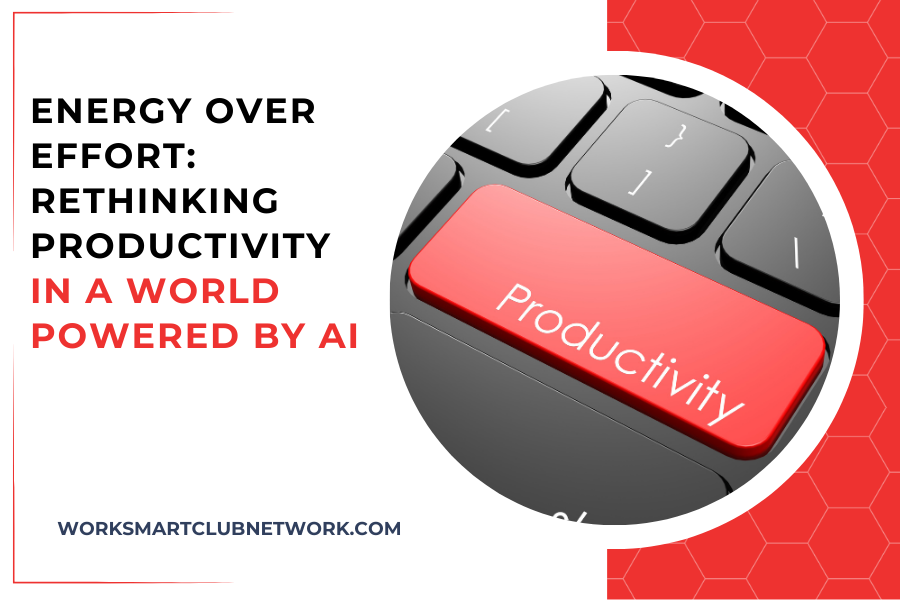
For decades, productivity has been measured by effort. Long hours, packed calendars, multitasking, and visible busyness became badges of honor. The harder you worked, the more successful you were perceived to be. But in a world increasingly powered by artificial intelligence, that equation is shifting.

AI can draft reports in seconds, automate workflows, analyze data at scale, and optimize operations faster than any human team. When machines can handle repetition and speed, human value must move elsewhere. The new advantage is no longer effort alone—it’s energy.

Energy is focus. Energy is clarity. Energy is creativity. And in an AI-driven world, managing your energy matters far more than simply increasing your output.

The Productivity Myth We’ve Outgrown

Traditional productivity culture rewards motion over meaning. We fill our days with meetings, notifications, and constant responsiveness. We measure success by how much we accomplish rather than by the impact of what we accomplish.

But more effort does not always equal better results. In fact, excessive effort often leads to burnout, poor decision-making, and diminished creativity. When mental energy is fragmented, performance declines—even if hours worked increase.

AI exposes this myth. If technology can complete tasks faster and more efficiently, then human contribution must shift toward higher-level thinking: strategy, innovation, emotional intelligence, and relationship building. None of these thrive under exhaustion.

The future belongs to professionals who understand that their competitive edge lies not in how much they can do, but in how well they can think. That requires preserved, protected energy.

Reframing productivity means asking a different set of questions:

  • Am I working in alignment with my highest-value strengths?
  • Am I using AI to eliminate low-impact tasks?
  • Am I protecting the mental clarity needed for strategic thinking?

When effort is no longer the primary metric, intention becomes the driver.

Leveraging AI to Protect, Not Drain, Your Energy

AI should not be another demand on your attention—it should be a strategic support system. Used intentionally, it can dramatically reduce cognitive load.

Automation tools can manage scheduling, organize data, summarize long documents, and even generate first drafts of content. These capabilities free up mental bandwidth. Instead of spending energy on repetitive execution, you can invest it in analysis, leadership, and innovation.

However, the paradox is real: without boundaries, technology can overwhelm. Notifications, constant updates, and tool overload fragment attention. The key is disciplined integration.

Choose tools that genuinely simplify your workflow. Consolidate platforms where possible. Create structured times to engage with digital communication rather than reacting continuously throughout the day.

AI should function as an amplifier of focus—not a competitor for it.

When leveraged correctly, artificial intelligence becomes an energy-saving ally. It handles the mechanical so you can concentrate on the meaningful. It processes speed so you can apply wisdom.

The real productivity advantage emerges when humans and technology operate in complementary roles rather than in competition.

Designing an Energy-Centered Work Model

An energy-centered approach to productivity begins with awareness. Notice when you feel most focused and creative during the day. These are your high-energy windows. Protect them for deep, strategic work.

Reserve lower-energy periods for administrative tasks or AI-assisted execution. Aligning task difficulty with energy levels increases both efficiency and quality.

Equally important is recovery. Rest is not a reward for productivity; it is a requirement for it. Mental renewal fuels innovation. Breaks improve decision-making. Boundaries protect long-term performance.

Leaders and professionals who prioritize energy management often experience:

  • Clearer thinking
  • Faster strategic insight
  • Stronger emotional intelligence
  • More sustainable performance

This shift also requires redefining success metrics. Instead of celebrating how busy you are, measure the quality of your outcomes. Instead of tracking hours worked, track meaningful progress made.

In a world powered by AI, your humanity is your differentiator. Creativity, empathy, ethical judgment, and visionary thinking cannot be automated. But they can be depleted.

Energy, therefore, becomes your most valuable resource.

The future of productivity is not about squeezing more into your day. It is about aligning your energy with what truly matters and leveraging AI to support—not replace—your highest capabilities.

When you prioritize energy over effort, you stop chasing busyness and start building impact. And in an era defined by intelligent machines, the most powerful strategy is cultivating an intelligent, well-managed self.

Monthly Tips

Transitioning from military service to civilian life is more than a career change—it’s an identity shift. For Sarah Williams, retired Air Force Special Operations officer and now CEO of Firewatch Magazine, that transition became an opportunity to redefine leadership, purpose, and impact beyond the uniform.

After 26 years of service, Sarah faced a question familiar to many veterans: What comes next? The military provided structure, mission clarity, and a deep sense of camaraderie. Civilian life, by contrast, offered freedom—but also uncertainty. Rather than retreating, Sarah leaned into the principles that guided her military career: resilience, decisive action, and service to others.

From Consultant to Entrepreneur: Decisive Action in Motion

Sarah’s journey into entrepreneurship began intentionally. After retiring, she sought roles that allowed her to continue supporting veterans, first responders, and law enforcement communities. This search led her to Firewatch Magazine, a publication connecting these groups with resources, services, and opportunities beyond service.

A defining moment came unexpectedly. While working as an advertising consultant, Sarah was let go as the magazine’s owners shifted focus. Within 24 hours, she called them and offered to buy the company—transitioning from employee to owner overnight. The acquisition, finalized on April 1st, marked the start of a new chapter.

Her decisiveness was shaped by military experience. Missions launched under ambiguity—like those after September 11th—taught her to move forward without complete clarity. “You don’t always know where you’re going,” she explained, “but you move forward anyway.”

Resilience, Sarah says, is less about avoiding failure than about getting back up repeatedly. This mindset was evident even in her youth. As a high school senior on the way to a critical service academy interview, a car accident could have derailed her future. A police officer intervened with a simple act of grace, letting her continue to the interview. That moment shaped her lifelong commitment to paying it forward.

Building Firewatch and Paying It Forward

Under Sarah’s leadership, Firewatch—named for the military tradition of “having someone’s back”—has evolved into a B2B connector platform. Beyond advertising, the company now offers event planning, strategic introductions, and “boots on the ground” representation for businesses entering U.S. markets. Sarah calls herself the Patriot Planner, bridging organizations with the communities they aim to serve.

The transition to business ownership required learning new skills—sales, technology, and backend operations—but Sarah approached it like a mission: surround yourself with experts, ask for help, and focus on the end goal. Networking became a tool for building trust and long-term opportunity, not just a transactional activity.

She also prioritizes helping veterans navigate civilian life. Programs like TAP, STAR, and nonprofit initiatives offered critical support, providing exposure to new industries, interview skills, and professional networks. “You come from a world where everyone has your back,” she explains. “Civilian life is different—but support still exists if you seek it.”

For Sarah, success is defined by time and impact. With 86,400 seconds in every day, she measures success by how intentionally those seconds are spent in service to others. Her guiding belief: the greatest test of leadership is absence. If an organization thrives because you were there—even after you leave—you’ve created lasting impact.

Sarah Williams’ story is a powerful reminder that leadership doesn’t end with service—it evolves. Through clarity, courage, and community, veterans and leaders alike can turn transitions into opportunities to serve, grow, and leave a meaningful mark

Click the image above to watch the full episode!

Monthly Tips

March often arrives with momentum. The first quarter is nearly complete, goals set in January are being tested, and the reality of packed calendars, competing priorities, and endless notifications begins to settle in. What started as clarity can quickly become chaos.

If you’re feeling overwhelmed, you’re not behind—you’re at a decision point. March is not just a checkpoint; it’s an opportunity to reframe. Instead of asking, “How do I do more?” the better question might be, “How do I do what matters better?”

Growth isn’t about adding more. It’s about optimizing what already exists—your time, your tools, and your thinking.

Rethinking Time: From Scarcity to Strategy

Overwhelm often stems from a scarcity mindset around time. We tell ourselves there isn’t enough of it. We react instead of plan. We fill every open space instead of protecting what’s essential.

Optimization begins when you stop measuring productivity by volume and start measuring it by value. Not every task deserves your prime energy. Not every email needs an immediate reply. Not every opportunity aligns with your priorities.

Start by identifying your “high-impact hours”—the times of day when your focus is strongest. Schedule strategic work during those windows. Use lower-energy periods for administrative or routine tasks.

Time blocking, delegation, and clearer boundaries are not luxuries; they are leadership tools. When you treat your calendar as a strategic asset rather than a to-do list, you shift from being busy to being intentional.

Reframing time means asking:

  • What truly moves the needle?
  • What can be automated?
  • What can be eliminated?

Growth accelerates when clarity replaces clutter.

Leveraging Technology Without Losing Control

In an AI-driven world, technology promises efficiency—but without intention, it can increase distraction. Notifications multiply. Platforms compete for attention. Tools meant to simplify work sometimes complicate it.

The key is not to reject technology but to use it strategically. Artificial intelligence and automation tools can streamline repetitive tasks, generate insights, and enhance decision-making. The difference between overwhelmed and optimized professionals often comes down to how they deploy these tools.

Use AI for drafting, summarizing, data analysis, and idea generation—but keep human judgment at the center. Automate recurring tasks such as scheduling, follow-ups, and reporting. Consolidate platforms where possible to reduce digital fragmentation.

Technology should expand your capacity, not fragment your focus.

The question shifts from “What new tool should I try?” to “What existing tool can I use more effectively?”

When technology becomes a partner rather than a distraction, you reclaim mental space for creativity, strategy, and connection—the elements machines cannot replicate.

Redefining Growth: Work Smart with Time and Energy

We often associate growth with expansion—more clients, more revenue, more responsibilities. But sustainable growth requires energy management, not just time management.

Energy is your most valuable currency. When it’s depleted, productivity suffers. When it’s protected, performance rises.

Working smart means:

  • Prioritizing rest and recovery.
  • Setting boundaries around availability.
  • Aligning work with purpose.
  • Saying no to what drains you.

March is the perfect time to audit your commitments. What feels aligned? What feels heavy? What no longer fits the direction you’re heading?

Growth in an AI-driven world is not just about keeping pace with innovation—it’s about staying grounded in clarity and intention. Technology may accelerate output, but it cannot define meaning.

When you combine strategic time management, intentional technology use, and disciplined energy stewardship, you create a sustainable system for success.

From Reaction to Reframe

Optimization is ultimately a mindset shift. It’s moving from reactive to proactive. From scattered to strategic. From overwhelmed to aligned.

Reframing doesn’t require a complete overhaul. It requires awareness and small, consistent adjustments.

  • Replace multitasking with focused execution.
  • Replace constant availability with defined boundaries.
  • Replace tool overload with purposeful integration.
  • Replace “doing more” with “doing what matters.”

March can become your pivot point—the month you stop chasing productivity and start designing it.

The most successful professionals in today’s rapidly evolving landscape aren’t the busiest. They are the most intentional. They understand that growth is not about speed; it’s about direction.

As you move through this month, consider what needs reframing in your world. Your time? Your technology? Your definition of growth?

When you optimize those three areas, overwhelm transforms into momentum. And momentum—built on clarity and strategy—creates results that last far beyond March.

Monthly Tips

We sat down with technology leader and author Alison Crews to explore an unexpected intersection between two worlds that rarely meet: the relentless, high-stakes pace of cybersecurity leadership and the quiet, patient work of building both a home and a marriage. Alison traces her journey from a high school coding project—an early precursor to a dating app—to leading global technical teams responsible for securing the data pipelines that power modern life.

In her world, data is currency, and cyber teams live under constant pressure to break systems, rebuild them, and break them again before attackers do. That rhythm demands more than technical skill; it requires continuous learning, clear communication, and a leader’s steady calm. Alison emphasizes staying sharp through ongoing training, daily monitoring of vulnerability disclosures, and vigilance around emerging threats, all while protecting the trust clients place in unseen, behind-the-scenes work. Her leadership mantra is simple but demanding: stay curious, stay prepared, and honor the people doing the invisible work.

From Blueprints to Belonging

The conversation takes a personal turn when Alison shares the origins of her debut book, The Big Reveal: Keys to Building Your Dream Home and Your Dream Marriage. Long before the manuscript existed, she felt a persistent nudge—waking at 4 a.m., compelled to write. What began as journal entries eventually became a framework connecting real estate milestones with relationship wisdom.

Finding a master builder mirrors choosing a trustworthy partner. Permits resemble granting access to your inner life. Inspections echo the hard conversations that establish boundaries. Closing day reflects commitment, stewardship, and long-term responsibility. These aren’t clever metaphors; they are practical principles that help readers make better decisions about love, stability, and the structures they inhabit. Alison’s thesis is clear: the homes we build outside reflect the foundations we pour within.

Redefining Home Through Loss and Legacy

Alison’s understanding of “home” was shaped early by loss. Born two weeks after her father passed away, she was raised by a mother from the Gullah community of the Sea Islands—a culture rooted in resilience, heritage, and communal care. Faced with grief, her mother chose connection over withdrawal, pouring love into her children instead of retreating.

That choice became Alison’s first blueprint for security, belonging, and purpose. She believes early environments set our internal compass: we either chase what feels familiar or learn to seek what is truly good for us. Maturity lies in knowing the difference. For Alison, home isn’t a physical address; it’s the experience of safety, truth, and shared growth with the people you love. That reframe invites readers to build lives aligned with their values, not just their expectations.

Faith, Discernment, and Strong Foundations

Faith anchors Alison’s leadership and her writing. She describes learning to recognize God’s voice through patience and practice—guidance that never contradicts His character or His word and often repeats through patterns, people, and timing. Her advice is to wait, write, and watch for confirmation rather than rushing decisions.

That same posture strengthens teams. In cybersecurity, speed is critical, but restraint is equally vital. Strong leaders create space to test, verify, and respond with precision. The parallels extend to relationships: grant access thoughtfully, inspect intent, and build with a plan. When foundations are solid, you can withstand stress, patch vulnerabilities, and continue growing. Whether leading engineers or nurturing a family, Alison’s message holds firm—foundations come first. Build them well, and the rest will stand.

Click the image above to watch the full episode!

Monthly Tips

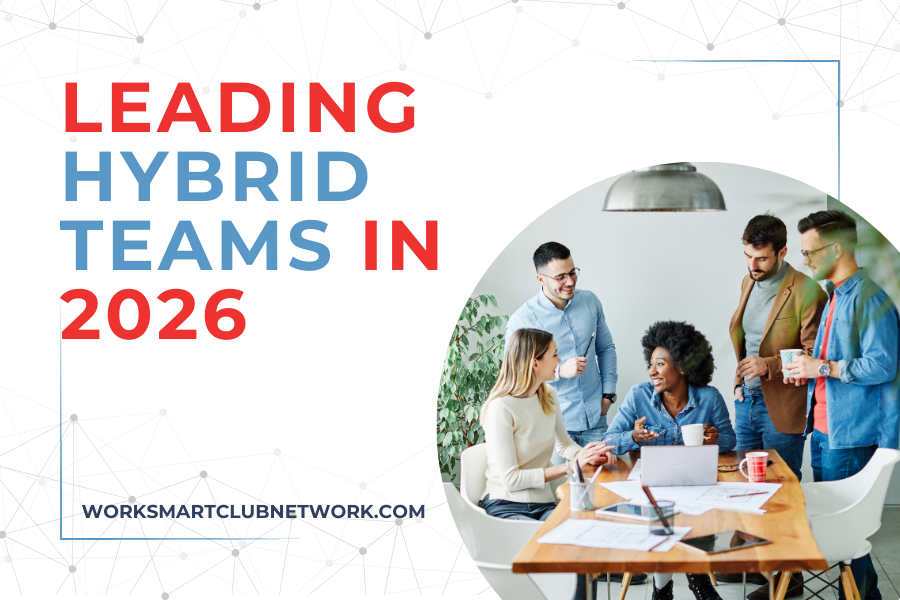
Hybrid work is no longer a trend but has evolved into the modus operandi for many companies. Many organizations now operate with flexible, distributed teams that blend on-site and remote work. This has created a huge opportunity for agility, diversity, and talent retention. Leaders are now required to have a deep understanding of how hybrid teams work and navigate this way of working with intentionality in order to effectively lead these types of teams. 

Here are three key things that leaders should master in order to effectively and efficiently lead their hybrid team to success: 

Master Clear and Intentional Communication

Having clarity in communication is one of the main foundations of any successful hybrid team. It is important for leaders to adopt and embrace a digital-first communication style where information is accessible, transparent, and thoughtfully distributed to both remote and on-site employees. This will see decisions, discussions, and updates being documented in shared spaces to ensure no one is left out simply because they weren’t physically present in a meeting room. Rather than relying on unplanned chats or on-the-spot office updates, the hybrid modality will require successful leaders to create structured communication routines that make expectations explicit and easy to follow. By prioritizing asynchronous communication for status updates and reserving real-time meetings for moments that genuinely require dialogue, leaders can ensure that every team member, regardless of location, has equal visibility and understanding. When communication systems are clear and intentional, hybrid teams become more aligned, engaged, and empowered to deliver their best work.

Setting Clear Goals and Creating a Culture of Accountability

Hybrid teams operate most effectively when clear expectations and shared goals are the guiding principles. In a hybrid environment, the most effective teams are those whose accountability is based on outcomes rather than hours logged or physical presence in the office. In order to lead a successful team, leaders must articulate what success looks like, define roles and responsibilities, and ensure that everyone understands how decisions are made and how progress will be measured. Regular check-ins are essential to ensure team members are aligned, obstacles are removed or minimized, and progress is celebrated. By creating transparent systems for tracking goals and performance, leaders empower team members to take ownership of their work and stay connected to the broader mission. Accountability becomes a collaborative effort, where individuals feel both supported and responsible for delivering high-quality results. This clarity not only boosts productivity but also enhances confidence and trust across the team.

The Art of Building a Culture of Trust and Equity

Trust is the glue that holds hybrid teams together, and leaders must intentionally build cultures where autonomy, fairness, and equal opportunity are the norm. In hybrid settings, trust means shifting away from managing by visibility and instead focusing on results, accountability, and shared purpose. Leaders should empower employees to manage their own workflows, recognizing that flexibility often leads to higher engagement and better outcomes. Just as importantly, they must ensure that remote employees have the same access to resources, mentorship, recognition, and career growth as their in-office counterparts. Without this, hybrid teams can easily fall into patterns where remote employees feel excluded or overlooked. By creating equitable systems and rituals that bring people together, leaders foster unity and reduce the invisible divide between remote and on-site staff. A culture rooted in trust and equity not only strengthens team cohesion but also leads to better organizational performance.

Hybrid work is no longer a temporary phase; it is the new reality of modern work. These capabilities help create workplaces where people feel valued, connected, and motivated, no matter where they’re located. Leaders who invest in these skills will not only elevate their teams’ performance but also build more inclusive, resilient, and future-ready organizations.

Monthly Tips

Entrepreneurs are often described as “born, not made.” But that narrative overlooks a powerful truth: many entrepreneurs are built—through experience, loss, reflection, and the courage to choose meaning over comfort. This truth came alive during a recent Real Talk conversation with business coach J.R. Espino, whose journey from corporate leadership to entrepreneurship is anything but ordinary.

With over 27 years at the same company and more than two decades of leadership experience, J.R. had every reason to stay in corporate America. His career was stable, successful, and respected. Yet a series of profound personal losses—family, close friends, his wife, brother, and mother—pushed him to reevaluate his purpose. These moments of grief clarified a deeper calling: not just to succeed, but to make meaningful impact.

From Corporate Leadership to Purpose-Driven Entrepreneurship

Despite his professional achievements, J.R. felt compelled to create a different kind of influence—one rooted in service, connection, and impact. Leaving a long-standing corporate role required courage, trust, and a willingness to step into uncertainty. What made the transition possible was recognizing that his corporate work—coaching, mentoring, and developing people—was already aligned with his passion.

As a certified Maxwell Leadership Team member and Dale Carnegie coach, J.R. had long believed in purpose-driven leadership built on trust and engagement. Entrepreneurship simply allowed him to expand those principles to a broader audience, helping small and medium-sized businesses define success beyond revenue and growth. For many of his clients, success shows up as stronger teams, healthier organizational cultures, and leaders who learn to delegate and trust more effectively.

Lessons in Leadership, Loss, and Growth

One of the most overlooked challenges for leaders is letting go. J.R. works with business owners who feel stuck because they believe everything depends on them. Coaching helps reveal blind spots, clarify strengths, and reframe delegation as a gift—for both the leader and their team. At the core of his philosophy is the idea that leadership is not about control, but influence. When people feel valued and connected to purpose, performance naturally follows.

J.R.’s approach is deeply shaped by lived experience. Loss taught him resilience, grief expanded his empathy, and challenges stretched him into a stronger version of himself. He often uses the analogy of a rubber band: when stretched and released, it doesn’t return to its original size—it grows. The same is true for people.

For those feeling stuck, his advice is simple: take action. Knowledge alone isn’t power—action is. Progress matters more than perfection. Growth begins the moment you decide to move, even in small ways. Coaching isn’t about being told what to do; it’s about expanding perspective, uncovering blind spots, and helping people see possibilities they couldn’t on their own. Just as elite athletes rely on coaches to maximize their talent, leaders benefit from guidance that accelerates intentional growth.

J.R.’s story is a reminder that entrepreneurship is not always a straight line fueled by confidence alone. Sometimes, it’s a quiet decision shaped by loss, purpose, and the realization that your best work may still be ahead.

You are not born into your calling. You are built into it. And often, your best is yet to come.

Click the image above to watch the full episode!

Monthly Tips

Deadlines, titles, and the pressure to prove yourself seem to be what is defining the fast-paced professional world of the 21st century. As we progress throughout our careers, we tend to seek external validation, hoping to find a sense of fulfillment. However. Many often realize that the sense of fulfillment is out of reach. 

From the outside looking in, careers that are driven by pressure may seem successful, but they often leave us feeling drained, disengaged, and disconnected. However, by building a career that is focused on purpose instead of pressure, you can reignite your passion, align your work with your values, and create long-term fulfillment. In this post, we’ll explore three practical ways to shift from stress-driven success to meaningful, purpose-driven growth so you can thrive, not just survive, in your career.

Mindset Shift – From External to Internal Validation

In order to build a career that is rooted in purpose, you first need to shift your mindset and start placing greater focus on internal validation vs. external validation. Instead of your career being guided by what is expected by others, you can build a career that is guided by what matters most. 

Shifting your mindset means pausing to reflect on what truly matters to you. You can use these questions to guide your reflection:

  • Am I pursuing this project because it excites me, or because it looks good on paper?
  • Does this role align with my values and long-term vision? 

Making career decisions from a place of alignment, rather than obligation or fear, may feel unfamiliar at first, but it creates clarity, motivation, and a stronger sense of ownership over your professional journey.

View Career Pivots as Growth Opportunities

Many individuals find that their initial career path may not be the right fit for their lifelong goals and aspirations. As people mature, they identify new interests and purposes, some of which may not be in alignment with the field that they are currently in. Purpose does not always follow a straight line, and as such, it is imperative that pivots are viewed as a necessary step towards career and personal alignment instead of a failure. 

Learning new skills can help with unearthing or clarifying your true strengths and interests, therefore informing your career choice. A pivot does not always mean starting from scratch. It also means making intentional shifts that bring your work closer to what matters most. As such, aim to embrace flexibility when it comes to your career, and navigate your career with curiosity and confidence, rather than pressure and fear.

Connect with People and Experiences that are Purpose Driven

Your environment has a powerful impact on your career mindset. Being surrounded by colleagues, mentors, and communities that model purpose-driven work can reinforce your values and inspire you to stay aligned with your goals.

Seek out mentors who prioritize impact over accolades, join professional networks that reflect your values, or participate in projects that excite and energize you. Purpose-driven influences can help you maintain perspective during high-pressure seasons, remind you of your long-term vision, and encourage sustainable growth. The right environment doesn’t just motivate you; it also keeps you grounded in what truly matters.

Building a career rooted in purpose isn’t about abandoning ambition or avoiding challenges. It is more about redefining what success means for you. By shifting your mindset, embracing pivots, and surrounding yourself with supportive, values-driven influences, you can transform your work from a source of stress into a source of fulfillment.

Monthly Tips

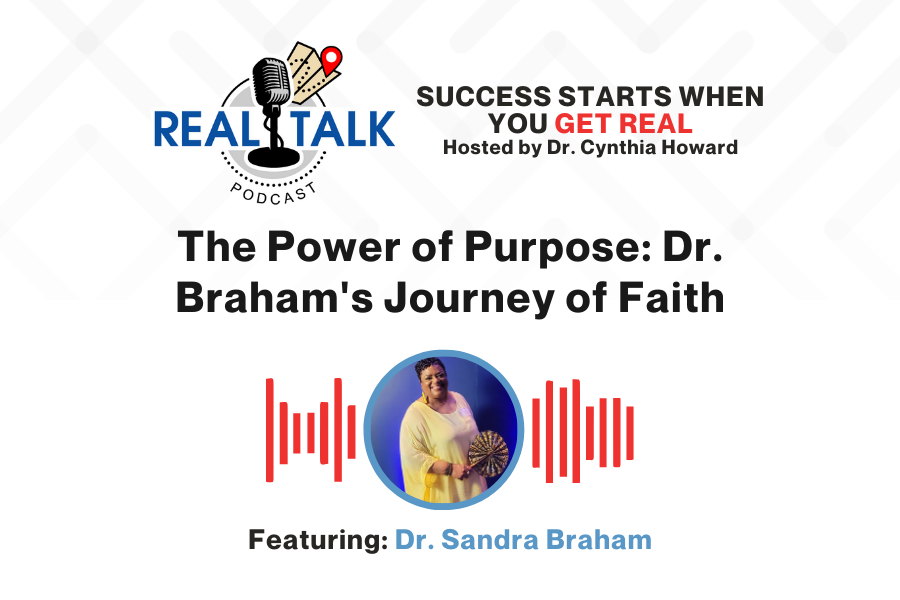
True leadership is rarely built on ambition alone. It is forged through purpose, shaped by discipline, and sustained by values that guide decisions when the path forward is unclear. This truth was powerfully illustrated during a recent Real Talk conversation with Dr. Sandra Braham, a visionary leader whose life and career exemplify how faith and purpose can fuel extraordinary impact.

Dr. Braham is the President and CEO of Gulf Coast Jewish Family and Community Services, a $57 million social service organization serving diverse populations with more than 650 employees. Under her leadership, the organization expanded by over $25 million in revenue while remaining deeply rooted in mission and values. She is also a trailblazer—becoming the first African American woman elected as Board Chair of the St. Pete Chamber—and the author of the acclaimed book An Angel for Detroit.

Leadership Shaped by Adversity and Faith

Dr. Braham’s leadership journey did not begin with titles or accolades. It began in adversity. Raised in St. Louis by a mother living with schizophrenia, she experienced instability early in life—foster care, periods of homelessness, and constant uncertainty. What sustained her through those seasons was faith. Church became a foundation, prayer became a lifeline, and education became a refuge.

“I learned early how to listen,” she shared. Listening—to God, to stillness, and to inner prompting—became a lifelong discipline.

Although she initially pursued medicine, Dr. Braham’s path shifted in college. She spent over a decade helping first-generation, low-income, and migrant students access and complete higher education, reflecting a consistent theme in her life: service with purpose.

Her transition into nonprofit executive leadership, however, was unplanned. A profound spiritual experience directed her to leave higher education and step into nonprofit management. Fulfillment came gradually, as doors opened and closed in unexpected ways, reinforcing a pattern she would come to trust: obedience over certainty.

Values-Driven Leadership in Action

Central to Dr. Braham’s approach is discipline—daily practices that keep her grounded. Scripture, prayer, reflection, and patience are not abstract ideals; they are tools she uses to discern decisions. Leadership, she explains, is a “dance” between humility and boldness.

One striking example involved a challenging promotion decision. After wrestling internally, she received clarity through a dream, which directed her back to her documented qualifications. Faith didn’t replace strategy; it illuminated it.

At Gulf Coast JFCS, decisions are filtered through mission and organizational values: respect, service, and repairing the world. Leadership, she says, means asking hard questions—Does this align with who we say we are? Does it do the most good for the most people? Ethical, values-driven leadership doesn’t mean decisions are painless, but it allows for redemptive outcomes, freeing others to pursue their own purpose.

Her book, An Angel for Detroit, reflects the same patience and obedience. First prompted in her teens, the work took decades to complete, involving 15 years of research, reflection, and family history exploration. Her advice to aspiring authors mirrors her advice to leaders: start, trust the process, and seek guidance. Purpose unfolds over time.

For new CEOs, Dr. Braham offers grounded wisdom: listen first. Learn the organization before making changes. Honor people. Understand culture. Leadership, she emphasizes, is relational at its core.

Dr. Braham’s story is a reminder that success rooted in purpose is not rushed, loud, or self-serving. It is intentional, disciplined, and deeply human. Leaders who align with their values don’t just build organizations—they create meaning for everyone they serve.

Purpose is not just what you do. It’s how you live, lead, and listen.

Click the image above to watch the full episode!

Monthly Tips


In an era where technology is evolving at breakneck speed, the way we approach our careers must also adapt. Dr. Cynthia Howard dives deep into the importance of developing microskills—the essential building blocks of larger competencies—especially in the context of artificial intelligence’s growing influence in the workplace. This blog post highlights key insights from Dr. Howard’s recent podcast and offers practical advice on how to harness these skills for professional growth.

Understanding Microskills

In her podcast, Dr. Howard emphasizes that while broad skills such as leadership and strategic planning remain crucial, the future of work demands a focus on microskills. These are the specific, nuanced abilities that fall under broader categories. For instance, resilience encompasses flexibility in thinking and the ability to quickly adapt to change. As Dr. Howard points out, our brain’s primitive survival instincts often hinder us from utilizing these skills effectively. In a world inundated with distractions, mastering microskills can help reduce reactionary responses and improve focus.

The Role of AI in Skill Development

Dr. Howard highlights the dual nature of AI in the workplace. On one hand, AI can augment our capabilities by managing vast amounts of data. On the other hand, it can also exacerbate distractions. To thrive in this landscape, professionals must learn to partner with AI intentionally. This involves not only leveraging AI tools to enhance their own microskills but also understanding how to provide the right data inputs for optimal results. For example, when managing conflict, relying solely on AI for solutions may yield generic advice; true resolution requires human insight and presence.

Identifying and Nurturing Your Microskills

A significant portion of Dr. Howard’s discussion revolves around self-assessment and discovery of one’s hidden strengths. She encourages listeners to reflect on their passions and the skills that drive them. For instance, if someone is organized, they should explore how that organization impacts their work environment. Dr. Howard shares a workshop experience where attendees identified their passion for family, drilling down to discover that their drive stemmed from a need to connect and preserve their legacy. This kind of exploration is vital for recognizing and articulating one’s unique value in the workplace.

Adapting to Change in the Workplace

The podcast also addresses the shifting dynamics in professional environments, particularly post-pandemic. Remote and hybrid work models have altered how we connect and lead. As AI increasingly takes over routine tasks, the challenge becomes ensuring that new employees gain the necessary experience and mentorship. Dr. Howard asserts that embracing change and fostering a mindset of continuous learning are essential in navigating this landscape.

As we continue to adapt to the ever-changing workplace environment shaped by AI and technology, focusing on developing microskills can unlock new career opportunities and enhance professional relationships. By reflecting on our strengths and understanding how to leverage them alongside AI, we can position ourselves as confident and capable leaders. Embrace the challenge of identifying and nurturing your microskills, and watch your career flourish.

Key Takeaways

1. Microskills are the foundational elements of broader competencies that are essential for career success in an AI-driven world.
2. Professionals must learn to partner with AI, using it as a tool for enhancing their own skills rather than relying on it entirely.
3. Self-reflection and assessment of hidden strengths are critical for understanding one’s unique value proposition in the workplace.
4. Adapting to changes in work dynamics is crucial for personal and professional growth, especially in the face of technological disruption.

Monthly Tips

As you navigate your career, there is inevitably a point in time when the enthusiasm and spark that you once felt start to fade. As routines repeat, necessary pivots take place, and burnout is worn like a uniform, what once felt meaningful can start to feel exhausting or misaligned. This can leave you questioning not just your job but your purpose. This month, instead of pushing through on autopilot or rushing to make a drastic change, consider a different approach: re-loving your work. Reigniting your career doesn’t always mean starting over; sometimes it means reconnecting, realigning, and choosing to show up with renewed intention right where you are.

Reconnecting—Reconnect with what brought you to this career path.

Re-loving your work is a step-by-step process, and the first step in this process is recalling to memory what led you to choosing this career path to begin with. The original motivation can sometimes get lost in the constant routines, deadlines, and exhaustion. As such, as you aim to reconnect with your work, it is important to reflect on:

  • What initially excited you about the work? 
  • What skills were you eager to use?
  • What moments in your career made you feel most fulfilled and effective? 

Reflecting on these areas helps with reintroducing a sense of meaning. This is not about relieving the past but is more so about reclaiming parts of your work that still matter and allowing them to inform how you move forward.

Taking Action – Take small intentional steps to reconnect with your work 

The second step in this process is realignment and being intentional about the actions that are being taken to reconnect. Career renewal oftentimes begins with small adjustments that are focused on restoring energy, focus, clarity, and a sense of ownership instead of immediate drastic changes. Taking small steps helps you to remain consistent and creates room for the actions to become habits. 

Some small but impactful actions that can be taken are: 

  • Making room to do work that is in alignment with your strengths
  • Experimenting with new activities that are in alignment with your work
  • Creating and enforcing boundaries that protect your creativity and focus
  • Advocate for clarity in your work, growth, and support

At this stage, the key is to remember that passion grows through action and not by waiting for motivation to magically return. Small wins create momentum, and momentum is what reignites belief, energy, and purpose in your work.

Realignment – Identify what loving your work looks like in the season that you are in

The current social media landscape can sometimes create the misconception that loving your work means that you are excited about work, inspired, or feel fulfilled one hundred percent of the time. However, in reality, work moves through seasons similar to other areas of our lives. In some seasons, loving your work looks like stability, obedience, growth, or preparation and less like excitement and intrigue. It is important to be cognizant of this in order to release unrealistic expectations and define what success means to you based on where you are at this point in time. This also helps with avoiding or releasing self-judgment when your reality does not align with social media ideals. By taking stock of where you are now, you can redefine what success truly means for your current season, whether that’s deepening your expertise, cultivating resilience, building relationships, or laying the groundwork for future opportunities. This kind of realignment allows you to approach your work with clarity, focus, and purpose, and allows you to find fulfillment in progress, alignment, and intentionality, rather than in a constant high of excitement.

Re-loving your work is not a single moment of inspiration. It takes a deliberate, ongoing process of reflection, action, and realignment. By reconnecting with what first drew you to your career, taking small, intentional steps to engage with your work, and redefining what success and fulfillment look like in your current season, you can rediscover purpose and passion without feeling pressured to start over. Remember, it’s not about chasing constant excitement or comparing yourself to the highlight reels of others; it’s about finding alignment, creating momentum, and honoring the unique season you’re in. 

This month, give yourself permission to reclaim joy, take purposeful steps, and show up fully for the work that still matters. In doing so, you may find that the spark you thought was lost was simply waiting for you to reignite it.

Monthly Tips

From Monterrey to Tampa: A Journey of Depth and Drive

Arnie’s story begins far from the boardrooms and accelerators of Tampa Bay. He grew up in Monterrey, Mexico, studied humanities in Spain and philosophy in Italy, then earned an MBA that led him to the United States. Those moves formed a rare lens: commercial rigor plus humanistic depth. That blend shows up in Blitz, his sales and marketing agency helping tech firms go to market across the Americas. The mission is simple but demanding: meet customers where they are, align channels and partners to how buyers want to buy, and turn innovative ideas into repeatable revenue. Along the way, his journey threads through the 2008 crisis, losing homes, and rebuilding by chasing opportunity in Houston, Mexico City, and ultimately Tampa, where he mentors founders at Tampa Bay Wave.

Mapping Technology’s Shifting Eras

The conversation pivots from biography to a larger map of technology’s eras. Arnie traces the arc from the hardware-heavy 2000s to the cloud decade, then the 2022 “earthquake” when AI leapt from feature to foundational platform. That shift matters because it changes strategy and culture, not just tooling. Companies that treat AI as a bolt-on risk irrelevance; those that redesign workflows, data flows, and products around intelligent systems can accelerate growth. Yet the point is not fear. It’s fluency. He argues that jobs won’t be replaced by AI itself so much as by people who use AI outpacing those who don’t. This mindset reframes the future of work: every role, from finance and operations to healthcare and customer support, becomes a mix of human judgment and machine leverage.

Human Anchors in an AI World

Still, speed can blur what matters. The hosts press on a core question: what makes us human when machines simulate intelligence? Here Arnie’s philosophy background shines. He names three anchors no model can truly own: love, empathy, and purpose. Love shows up in sacrifice for family and community, something code can mimic in tone but not live in truth. Empathy is more than words like “sorry to hear that”; it is presence, care, and responsibility. Purpose is the why behind our choices. AI has objectives; humans have meaning. These are not soft add-ons. In a world where AI takes repetitive work, human distinctives become the new advantage. Leaders must create space where technology handles the routine and people deepen relationships, creativity, and ethical judgment.

Practical Steps to AI Fluency

Practical application ties it together. To stay relevant, adopt AI as a learning engine. Use it to draft, research, summarize, analyze data, and simulate scenarios, then layer your context, taste, and domain expertise. Build micro-skills: prompt clarity, verification, synthesis, and decision framing. Keep a bias for customer reality: what do they need, how do they prefer to buy, and which channels reduce friction? For teams, set simple guardrails: define quality standards, require human review for sensitive outputs, and measure time saved redirected into higher-value work. For culture, reward curiosity and collaboration, not just output. As Tampa grows into a tech hub—with strong universities, lower costs, and a supportive ecosystem—these habits help startups and enterprises alike turn AI into an advantage without losing their soul.

Purpose, Legacy, and Becoming More Human

The episode ends on purpose and legacy. For Arnie, success is living so his children and grandchildren are proud, helping others where possible, and leaving a mark through service and results. That frame offers a practical compass. Adopt AI to gain time; invest that time in relationships, mentoring, and meaningful work. If you have resisted AI, start small: one workflow, one tool, one measurable improvement. The goal is not to become a machine. It is to become more human—more focused, more present, and more capable—because the tools handled the rest.

Click the image above to watch the full episode!


2024 Monthly Tips

As we post tips you will access those here…

The Work Smart Signal Logo

Ruthless Focus for Leaders in an AI Driven World

We provide substantive articles & training on AI & leadership in this AI accelerated world. Join our network…